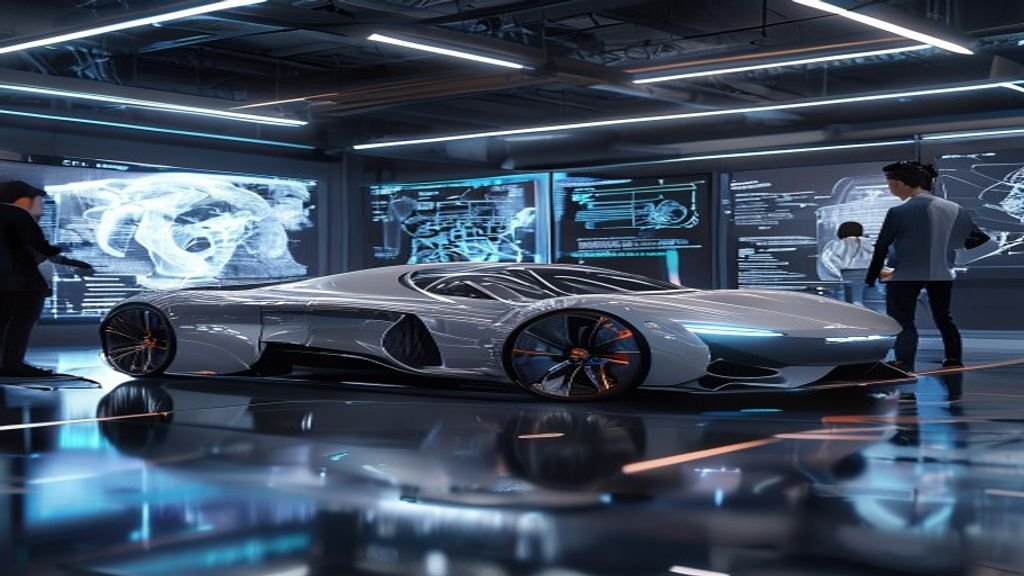
The AI-designed car is starting to look real
For years, artificial intelligence in the auto industry has mostly been framed around what happens after a car is built: voice assistants, driver-assistance systems, predictive maintenance, smarter navigation.
Now the focus is shifting earlier — much earlier. AI is increasingly being pulled into the design studio itself, where carmakers are experimenting with how algorithms can help imagine, draft, refine, and speed up the process of making a new vehicle.
That does not mean a chatbot is about to replace an automotive designer. But it does signal a real change in how the industry thinks about creativity, engineering, and time. The AI-designed car is no longer a vague future-facing idea. It is becoming part of the workflow.
Recent attention around efforts at major automakers, including GM and Nissan, points to the same underlying trend: AI is moving upstream. Instead of only powering features inside the vehicle, it is starting to influence the shape of the vehicle itself.
In practice, that can mean a lot of different things. Generative tools can produce large volumes of concept variations in a fraction of the time a human team would need. Machine learning systems can help surface patterns in earlier designs, flag likely engineering conflicts, or help teams explore new forms that balance aesthetics with aerodynamics and manufacturing constraints.
That is where the shift gets interesting. Car design has always been a mix of emotion and math. A vehicle has to look right, but it also has to be buildable, efficient, safe, and aligned with a brand’s identity. AI fits neatly into that tension because it can process options at scale while still leaving humans to decide what actually deserves to move forward.
Why it matters
AI’s role in cars is expanding beyond infotainment and autonomy. If automakers can use it to speed up design and engineering, it could reshape how vehicles get from concept to showroom — and who gets to make the key creative calls along the way.
There is also a business angle here. Vehicle development is expensive, slow, and packed with tradeoffs. Anything that helps companies test more ideas earlier — and kill weaker ones faster — has obvious appeal. In an industry under pressure to electrify, cut costs, and stand out in a crowded market, design speed matters.
But faster does not automatically mean better. The risk with any AI-assisted creative process is sameness. If the underlying tools are trained on broad pools of existing visual language, there is always the possibility that outputs start to converge. In car design, where brand distinction is everything, that is a serious concern.
That is one reason the human role still looks central. Designers do more than sketch attractive shapes. They translate a company’s identity into surfaces, proportions, and details people instantly recognize. AI may generate possibilities, but curating those possibilities — and rejecting the ones that feel generic, awkward, or off-brand — remains the real job.
There is another layer, too: engineering reality. A dramatic concept image is easy. A production vehicle that can meet regulations, survive manufacturing, and satisfy buyers is much harder. So even as AI tools improve, they are likely to be most useful when tied closely to the practical limits that define real-world car development.
That makes this moment less about a machine independently “designing” a car and more about the emergence of a new kind of collaborative stack. Designers, modelers, and engineers can use AI to shorten the distance between idea and evaluation. Instead of slowly moving from sketch to model to revision, teams can compress that loop and test more directions earlier.
What to know
- Automakers are increasingly using AI earlier in the vehicle development process, not just inside finished cars.
- Design teams are exploring AI for concept generation, iteration, and workflow acceleration.
- The shift raises bigger questions about authorship, quality control, and how much creative decision-making stays human.
- For now, AI looks more like a design partner than a replacement for car studios.
The bigger takeaway is simple: AI in the auto world is no longer confined to the dashboard or the data center. It is entering one of the most brand-sensitive, creatively charged parts of the business. That alone makes it worth watching.
The car of the future may still be designed by people. But increasingly, it looks like those people will be designing alongside machines.
Sources
- The Verge — The AI-designed car is taking shape