Feeble Little Horse Pushes Further Into Digital Weirdness on bitknot
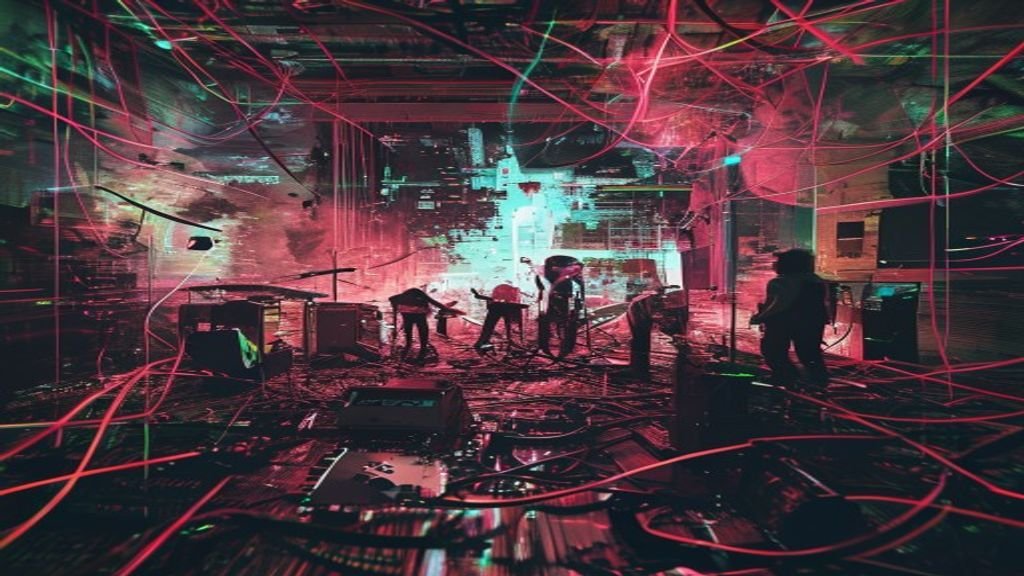
Feeble Little Horse is not in the business of cleaning things up. On bitknot, the band leans harder into friction, turning digital clutter, blown-out textures, and unstable edges into the main event.
The result is an album that feels both abrasive and deliberate. It doesn’t just flirt with glitchy production or internet-brained chaos. It commits to it. Songs seem built to wobble, crack, and smear at the edges, while still holding onto hooks that keep the whole thing from drifting apart.
That tension is what gives bitknot its charge. Feeble Little Horse has already built a reputation for making music that sounds shredded, overdriven, and emotionally off-center. Here, that instinct gets pushed further. The band’s mix of indie rock structure and digital distortion feels less like a stylistic trick and more like a worldview.
Plenty of guitar bands borrow from electronic messiness now. Fewer know how to make that mess feel alive. bitknot appears to understand that the appeal of digital weirdness is not just novelty. It’s instability. It’s compression pushed too far, melodies fighting through static, and songs that feel like they might collapse before they lock into place.
Why it matters
Feeble Little Horse is part of a wave of guitar bands rethinking what rock can sound like in a hyper-digital era. With bitknot, the group doesn’t smooth out the noise — it uses distortion, abrasion, and internet-age weirdness as the point, not just the packaging.
What makes that approach land is that the band does not abandon songcraft. Under the noise, there is still shape. Melodies cut through. Rhythms still hit. Even when tracks sound warped or overloaded, they move with purpose. The chaos is arranged, not random.
That balance matters because it keeps bitknot from becoming an aesthetic exercise. Albums built around sonic damage can flatten out if every idea points in the same direction. Feeble Little Horse seems more interested in contrast. The sharper and uglier the textures get, the more satisfying it is when a tune suddenly opens up inside them.
There is also something timely about the band’s approach. A lot of contemporary rock music now lives downstream from screens, compression, oversaturation, and fragmented attention. Instead of pretending otherwise, Feeble Little Horse appears to absorb that reality into the music itself. bitknot sounds plugged directly into a culture where beauty and distortion arrive at the same time.
That makes the album feel current without sounding trend-chasing. Its noise is not polished into something sleek. It stays rough. It stays a little alien. And that choice gives the record personality in a crowded field of genre-blurring releases that often end up feeling too frictionless.
Key points
- bitknot pushes Feeble Little Horse deeper into an intentionally fragmented, digital-first sound.
- The band mixes noisy guitars, blown-out textures, and melodic turns instead of choosing one lane.
- The album stands out by treating glitch and disorientation as core musical tools.
- Its release adds momentum to a broader shift in indie rock toward stranger, less polished production choices.
For listeners already tuned into Feeble Little Horse’s wavelength, bitknot looks like a sharper articulation of what the band does best. For newcomers, it may be a demanding entry point — but also a compelling one. The appeal is not instant smoothness. It’s the thrill of hearing a band make disorder feel intentional.
At a moment when so much music is engineered to go down easy, Feeble Little Horse is making a strong case for the opposite. bitknot doesn’t try to sand off its edges. It lets them scrape, spark, and stick.
That’s exactly what makes it hard to ignore.
Sources
- The Verge — Feeble Little Horse leans into digital weirdness on bitknot